In a traditional kitchen, we are taught to use a dozen different knives. But for the Urban Nomad, clutter is a cognitive tax. In the compact environment of a balcony, a massive knife block is an absurdity. What you need is a “Singular Blade”—a high-carbon, foldable or compact fixed-blade that bridges the gap between a Japanese petty knife and a rugged outdoor tool.
In the third edition of Nomad Kitchen, we cut through the noise of excessive cutlery.
1. The Geometry of the Fold
Most “camping” knives are too thick for delicate kitchen work.
- The Requirement: You need a thin blade geometry. Look for a knife with a “full flat grind” (like the classic Opinel No.08 or No.10). It allows you to slice a tomato translucent-thin while being light enough to vanish into your pocket once the meal is prepped.
2. Steel Temper: Carbon vs. Stainless
In a balcony lab, your tools are exposed to the elements.
- Carbon Steel: It takes a laser-sharp edge and develops a beautiful patina that reflects your cooking history. It requires care (refer to the “Ritual” in Nomad Kitchen #02), but for the purist, it’s the only choice.
- Stainless Steel: If you live in a humid, coastal city, modern high-end stainless (like Sandvik 12C27) offers the best balance of edge retention and corrosion resistance.
3. Tactile Safety and Storage
On a small balcony table, an exposed blade is a hazard.
- The Folding Advantage: A folding chef’s knife is inherently safer in a nomadic setup. When the prep is done, the edge is tucked away. No need for bulky magnetic strips or protective sheaths that take up space in your 60-Second Retreat crate.
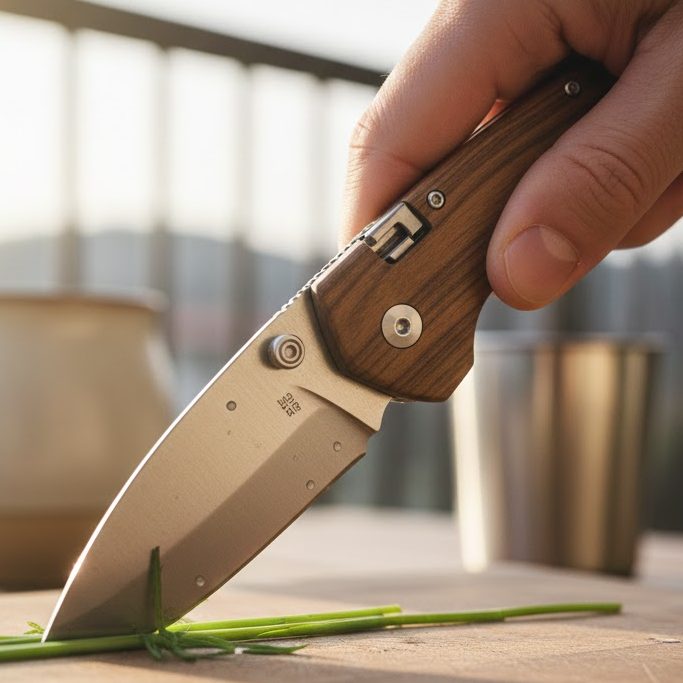
The “Single Knife Sunday.” Attempt to prepare an entire multi-ingredient meal using only one folding knife. From peeling garlic to dicing onions and slicing the final protein. You’ll realize that skill and a single sharp edge outperform a kitchen full of dull, specialized gadgets.